RESEARCH & PROFESSIONAL FOUNDATION
The TPES Knowledge Foundation: From personality research to AI empowerment
Understanding individual differences has been the starting point throughout TPES's development. From personality and multiple intelligences to talent assessment, competency models, and AI applications, explore where these methods come from and how they become part of everyday life and work.
From personality research to AI empowerment
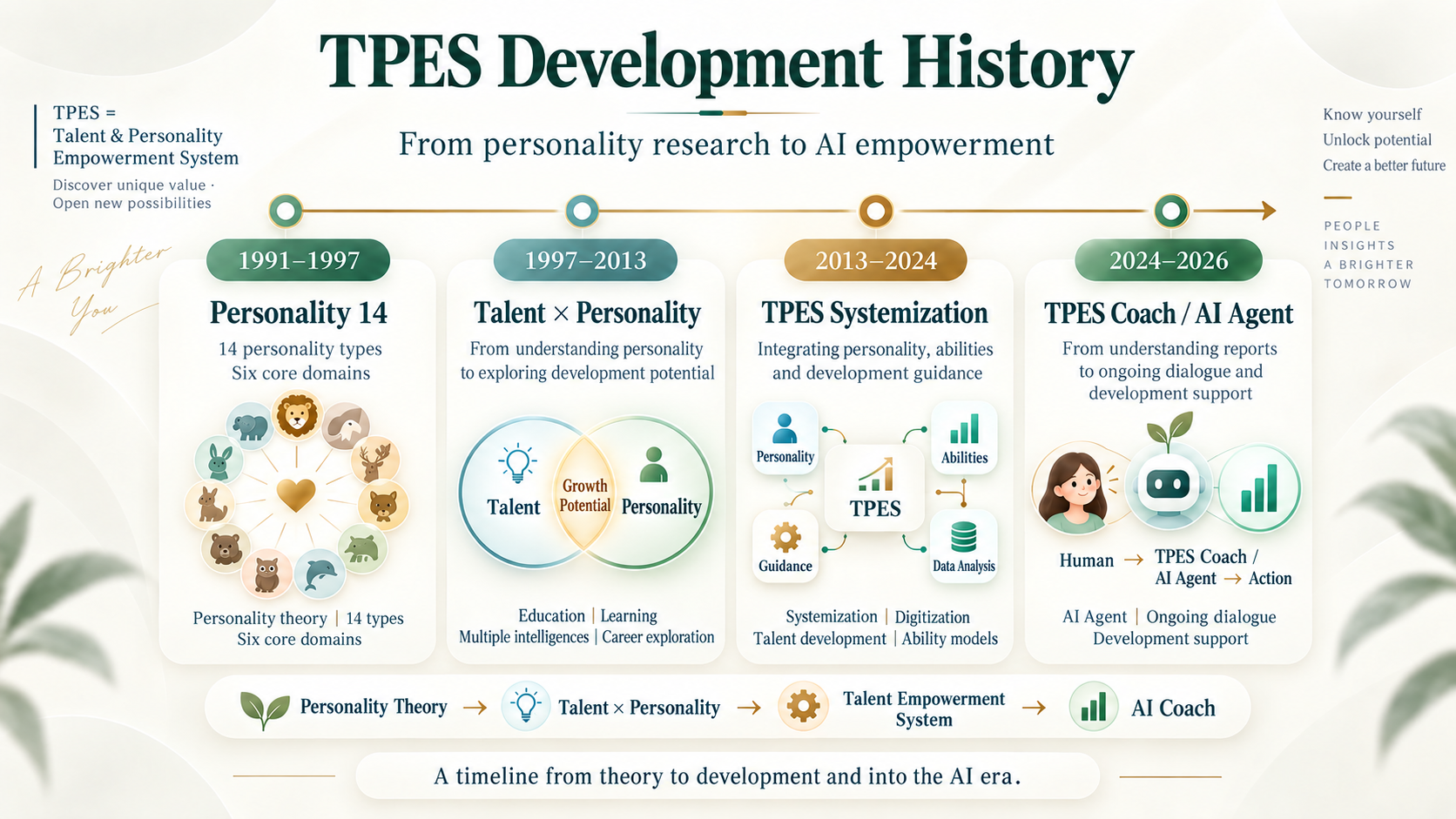
From recognizing individual differences to supporting development, each evolution brings understanding closer to everyday life and work.
View the Full DiagramResearch Matters When It Helps People Develop Themselves
Multiple Intelligences: Recognize more than one kind of ability
TPES introductory materials cite Howard Gardner's theory of multiple intelligences as a reference for exploring talent. It encourages us to understand people through different aspects of learning and performance, rather than defining potential by a single score. Citing the theory does not imply endorsement of the product by Harvard University or the theory's author.
Personality 14: Bring individual differences back into everyday life
Hsiu-Yuan Wang's Personality 14 uses 14 personality archetypes and the Six Core Domains to make personality, needs, and behavioral patterns accessible for reading, discussion, and observation. Publications and services bring the approach into work, education, and family life.
From Developing Methods to System and AI Applications
Nearly a century of research, ten million case records, and 40 years of empirical experience form the research foundation TPES has organized and extended. Today, these methods connect assessments, competency models, professional services, and AI applications. These research figures describe the background of the data and methods; they are distinct from website customer counts, product usage, and individual outcomes.
Theory and Personality Knowledge
Personality 14 and related publications offer an introduction to TPES personality terminology and its development. They provide perspectives for discussing individual differences, work, learning, and relationships.
Citing a theory or author does not mean that the author or institution has certified the entire platform, all algorithms, or every AI response.
TPES Models and Application Methods
TPES organizes assessment and application content around the relationships between personality, competencies, roles, and development. The 45-competency model provides a vocabulary of competencies that can be combined; applying role competencies requires connections to tasks, behavioral standards, and actual data.
AI supports organization, analysis, and conversation within the relevant methods and data scope. AI's ability to express ideas and the quality of an assessment itself are separate issues; neither can substitute for the other.
Five Books for Further Reading: Personality in Different Life Situations
Deepen your understanding of yourself and others through five areas: personality, parenting, learning, adolescence, and careers. Reading with real-life questions in mind makes meaningful clues easier to find.
Understanding Personality, Changing the Heart: Personality 14 | Hsiu-Yuan Wang
Reading Focus: Understanding Personality. A starting point for exploring Personality 14 and considering traits and life choices. As you read, relate descriptions that resonate with you to your actual experiences.
Understand the Child Before You Teach: Seven Childhood Personality Types | Hsiu-Yuan Wang
Reading Focus: Parent-Child Relationships and Parenting. Start by understanding differences among children, then discuss how adults can adjust their expectations and support. Different ages and situations still require appropriate developmental observations.
Learning Breakthrough: Strategies to Help Children Achieve High Scores | Hsiu-Yuan Wang
Reading focus: learning and support. Useful for extending discussions about learning methods and support from parents and teachers. Read alongside practical tasks, children's experiences, and teacher feedback.
The Brain Goes Through Adolescence Too! (2nd Edition) | Hsiu-Yuan Wang
Reading focus: understanding adolescents. Use these as supplementary materials for parents and teachers discussing adolescent development and interactions, not as a direct diagnosis of an individual child.
What Kind of Person for What Kind of Career | Hsiu-Yuan Wang
Reading Focus: Personality and Careers. Use it to reflect on the relationship between personality, work, and choices. Actual career decisions still require competencies, experience, circumstances, and job information.
Let Research, Practice, and Feedback Support Ongoing Development
Development records show how methods and products evolved step by step, helping us understand the foundations of today's applications.
Practice documents make methods more concrete: how to analyze, plan, and turn insights into action. Discussing changes in performance, employment, or relationships requires corresponding observation and follow-up.
Research on Measurement Quality The study version, participants, sample, methods, and limitations must be explained to understand where the findings apply.
Application Outcome Data Explain the comparison method, observation period, and other possible influences to avoid attributing every change to the tool.
Use research data to answer research questions and field feedback to improve applications. Together, they support better tools and services.
How do practical applications support ongoing improvement?
Businesses can calibrate role requirements through real work tasks; schools can refine exploration directions through practical training and student feedback; coaches can revise their understanding through conversations and action outcomes.
The value of these materials lies not just in the number of cases collected, but in identifying when a method helps, when it falls short, and what the next version should improve.
Research and teaching partnerships with clearly defined questions are welcome
Start with the relationship between personality and competencies in practice, role models, student development, talent development, or how AI supports professional work. Before collaborating, agree on the research question, data sources, authorization, ethical responsibilities, and what may be made public.
Bring your teaching, research, or professional questions to discuss partnership directions, data arrangements, and how outcomes will be presented.
COMMON QUESTIONS
Questions You May Have
Find useful answers to the questions in front of you.
Are 14 dimensions, 19 levels, and 16,384 classifications the same thing?
No. The 14 dimensions describe aspects of personality, the 19 levels describe the granularity within each dimension, and 16,384 is a separate classification and analysis count in the brand's materials. These are not customer counts or measures of predictive accuracy. The theoretical combinations of dimensions and levels are not described as multiples of the global population.
Where can I learn more about Personality 14?
This page brings together relevant publications and development records. Explore the 14 type introductions, the Six Core Domains, and assessment services to see how the methods are applied. Contact the team to discuss teaching, research, or publishing collaboration.
TAKE YOUR NEXT STEP
Give Your Next Step a Clearer Direction
Tell us your role, needs, and region,
We will help you find the right TPES platform, service, or partnership contact.