THE TPES SYSTEM

The TPES Universe: Discover potential and move toward development

Recognize your unique value and put your potential to work. TPES connects talents, personality, competencies, and development, helping you move from self-understanding and finding your place to taking action on a path that fits you better.

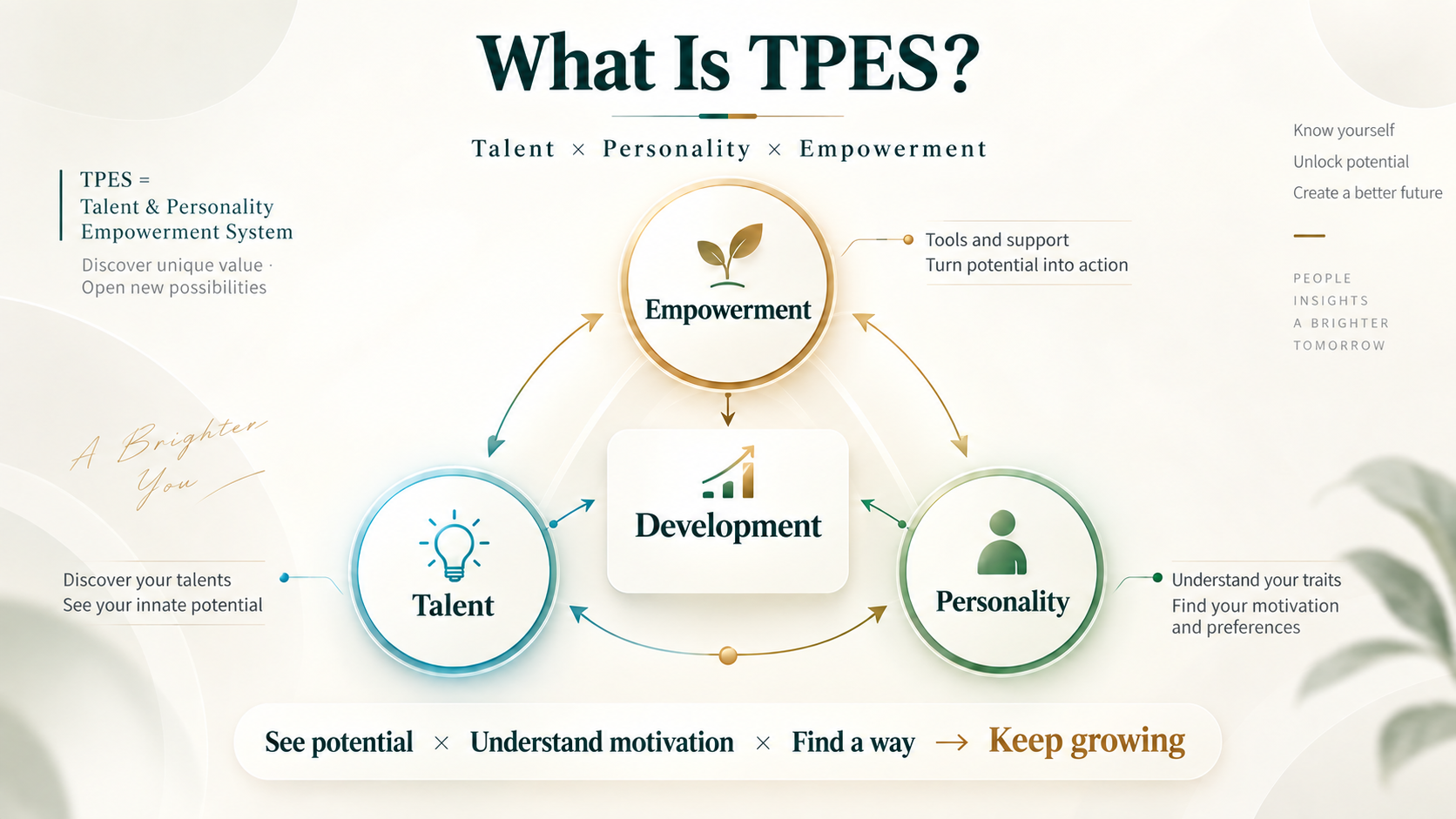
What Is TPES?

TPES connects talent, personality, and empowerment for ongoing development: discover potential, understand drivers, and provide tools and support.

See your potential, understand your drivers, and find your way forward. Understanding yourself is the first step toward changing your life.

View the Full Diagram

One TPES for Work, Careers, and Families

Life is more than work performance or a single assessment. TPES makes understanding people a shared starting point for organizational development, personal growth, and family wellbeing.

01

Organizational Excellence

Choose the right people and help them contribute more fully. From recruitment and talent reviews to manager development and team management, bring personality and competency information into every conversation about staffing, development, and motivation.

  • Know What to Ask Before the Interview
  • After a Talent Review, Find Where Each Person Can Contribute
  • Lead Teams by Supporting Different People in Different Ways
Explore This Direction
02

Career Success

Find your own direction instead of following someone else's answers. Connect talents, personality, competencies, and career choices, from students exploring majors to professionals changing careers, growing, or stepping into leadership.

  • Learning and Majors: Recognize Different Kinds of Potential
  • Work and Career Changes: Clarify choices and strengths
  • Ongoing Growth: Turn goals into practice
Explore This Direction
03

Family Wellbeing

Many conflicts begin with not understanding one another. Learn what matters to your partner and children, how they express themselves, and what support they need, giving parent-child, couple, and family conversations a better starting point.

  • Understand Differences Without Rushing to Label
  • Understand children and find the support that fits
  • Express Needs Clearly and Practice Better Communication
Explore This Direction

Coaches, schools, and professional institutions are partners in bringing these methods to more people.Explore Professional Partnerships

The depth of TPES comes from a comprehensive talent development system

Personality understanding, competency analysis, motivation, and development recommendations are connected. Rather than simply telling you your type, they help you see how you can contribute.

14Personality Dimensions
Recognize different needs, preferences, and behavioral tendencies.Learn More
19Dimension Levels
Describe traits in greater detail rather than selecting only a single type.Learn More
16,384Personality Classification and Analysis
Deepen personality understanding through different combinations of traits.Learn More
45Competency Indicators
Organized into six categories that connect roles with development directions.Learn More
9Motivation and Values
Understand what matters to you and what drives your engagement.Learn More
14Personality Risks and Development Suggestions
Recognize your strengths and identify areas worth adjusting.Learn More

Different numbers describe different levels of the framework, not accuracy rates or client counts. Report interpretation, contextual discussion, and development support help turn the information into a useful next step for you.

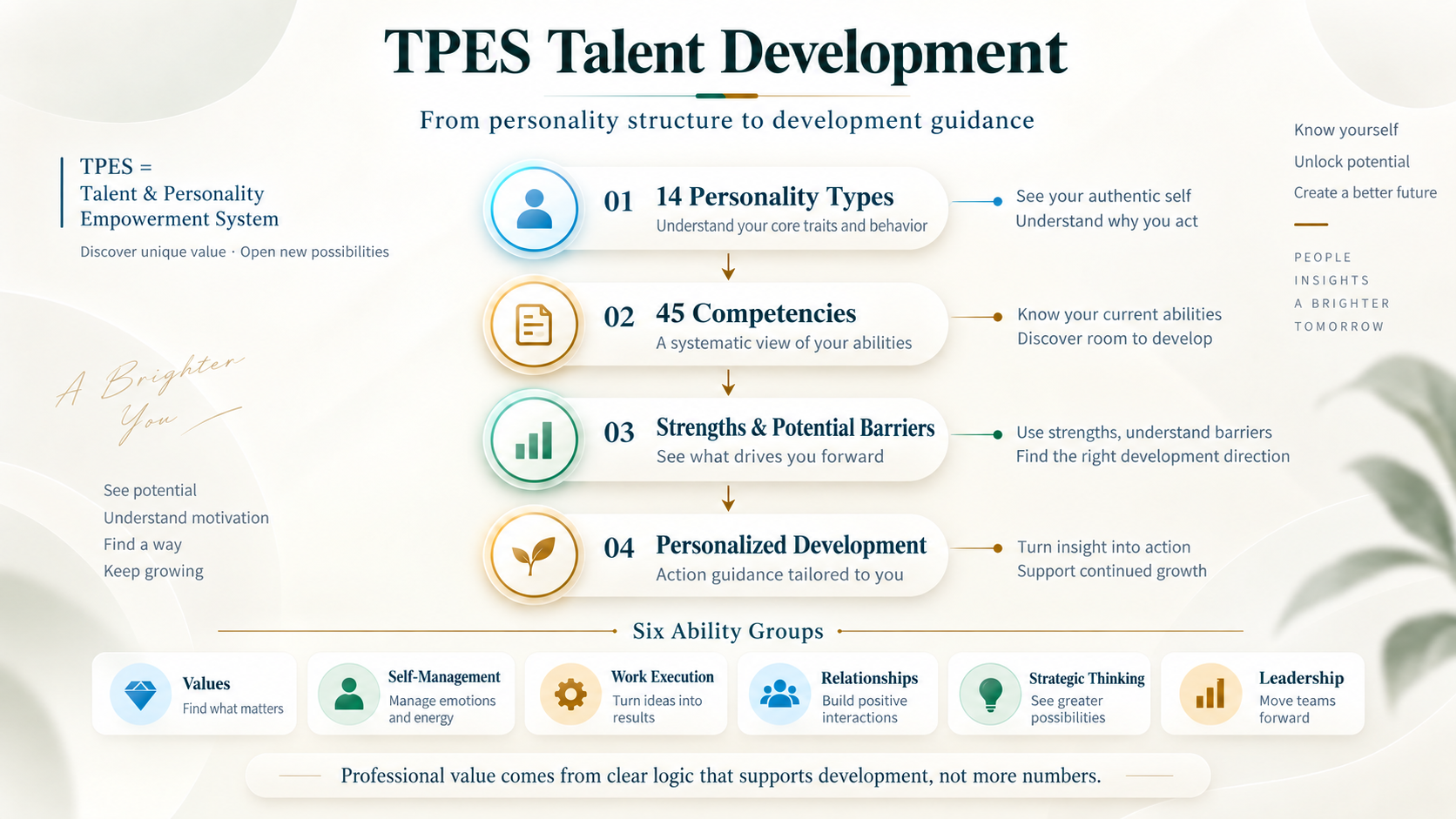
From Understanding Yourself to Making Your Own Way

TPES talent development framework: a 14-type personality structure, 45 competencies, strength-based drivers and potential barriers, and individualized development suggestions. Competencies are grouped into six categories.

Personality reveals how you see the world, competencies help you accomplish tasks, and development suggestions bring both into real life.

View the Full Diagram

Discover Yourself, Find Your Place, Keep Growing

Connect Understanding with Real Development
  1. See Yourself ClearlyTalent · Personality · Drivers
  2. Find where you can contributeCompetencies · Roles · Real Tasks
  3. Act with a practical approachPractice · Feedback · Ongoing Adjustment

Self-understanding is not the destination; putting your strengths to use is.

Discover: See What Makes You Unique

Begin with talents and personality to understand natural tendencies, inner needs, and behavioral patterns. See not only what you can do, but what draws you in and what tends to hold you back.

Positioning: Connect strengths with the right context

The same traits can appear differently in different roles. Consider competencies, experience, work tasks, and your own expectations together to discuss where you can contribute and what conditions and support you need.

Development: Turn Understanding into an Achievable Next Step

Start with a competency you want to strengthen, an important conversation, or a new role. Use development recommendations, coaching questions, and AI support to build your own approach to growth through practice, reflection, and adjustment.

Recognize What Matters to You and Understand Your Natural Tendencies

Personality 14 uses multiple personality dimensions to describe what a person may value, how they tend to respond and interact, and the circumstances in which they may face challenges.

Start with personality to understand someone more clearly: Do they need autonomy or clear standards? What motivates their engagement? Where do they tend to get stuck under pressure? Bring these clues into conversation and observation to find support that fits.

Turn scattered feelings into clear self-understanding

Assessments turn scattered self-observations into structured information, making it easier for individuals, teachers, managers, and coaches to begin a discussion. Different assessment versions, reports, and audiences address different questions. Confirm the purpose and appropriate scope before use.

Connect Potential with the Competencies Work Requires

Indicators across six competency categories provide a bridge between personality information and work requirements. For example, being outgoing does not automatically mean someone communicates well with customers. Listening, empathy, communication and coordination, and actual interactions also need to be considered.

Competency indicators also offer clues about potential, motivation, and current state. Add work experience, skills, and actual performance to build a fuller picture of how someone contributes now and how they can develop in the future.

Find a Role That Gives Your Strengths Room to Contribute

The same competency may matter differently across roles. When building a competency model, first ask: What goals must this role achieve? What are the key tasks? What level of performance meets the requirements?

Then use these requirements to select competencies, explain weightings, and gather behavioral evidence, rather than working backward from a personality label to a conclusion about the role.

Act with a Method and Keep Growing

For businesses, this can shape interview follow-up questions, talent discussions, or mentoring priorities. For schools, it can guide exploration and practical tasks. For coaches, it can support conversation preparation and action planning. For individuals, it can lead to one small step they are willing to try.

When users bring back real feedback, revisit whether the initial understanding fits. This makes assessment a reference throughout development rather than a one-time conclusion.

See How These Five Layers Work Together Through One Example

Application example: a manager wants to know whether a detail-oriented colleague is suited to leading a project.

Personality information may indicate a person's attention to quality, standards, or risk, but it cannot by itself establish their ability to lead a project. Next, identify the competencies required, such as analytical thinking, execution, communication and coordination, and resource integration. Then set observable tasks: can they delegate work, coordinate dependencies, handle schedule disruptions, and propose solutions with incomplete information?

AI can help organize analysis and design follow-up questions. Managers still need to observe actual performance, and employees need to express their own preferences. The outcome is not 'naturally suited or unsuited,' but clearer conditions for a trial assignment and specific development tasks.

Shared goals, different approaches to growth

Same score, different drivers. Similar scores may have different drivers and call for different forms of support.

Same role, different development. Meeting the same role requirements does not mean everyone must follow the same development path.

Refine understanding through behavior. New practical experience, performance, and feedback can revise the original assessment interpretation.

COMMON QUESTIONS

Questions You May Have

Find useful answers to the questions in front of you.

How do talent, personality, and competencies differ?

Talent concerns potential to explore; personality concerns habitual needs, preferences, and responses; competencies concern the performance needed to complete tasks. Consider them alongside experience, environment, and roles to explore where you can contribute and how you can keep growing.

How do the three series relate to the four platforms?

Organizational Excellence, Career Success, and Family Wellbeing are the application areas; Agent, Coach, Personality 14, and Happy Heart are the service entry points. You might use Agent at work and Coach for personal growth, while drawing on personality knowledge and relationship services to understand your family better. You do not have to fit into a single category.

TAKE YOUR NEXT STEP

Give Your Next Step a Clearer Direction

Tell us your role, needs, and region,
We will help you find the right TPES platform, service, or partnership contact.