08
Values
ValuesUnderstand what matters to you, giving work and choices a clearer direction.
45 ATOMIC COMPETENCIES
To grow, first know where to begin. TPES organizes 45 competencies into six categories, connecting your personality, role, and work context to turn a vague 'I want to do better' into a concrete development direction.
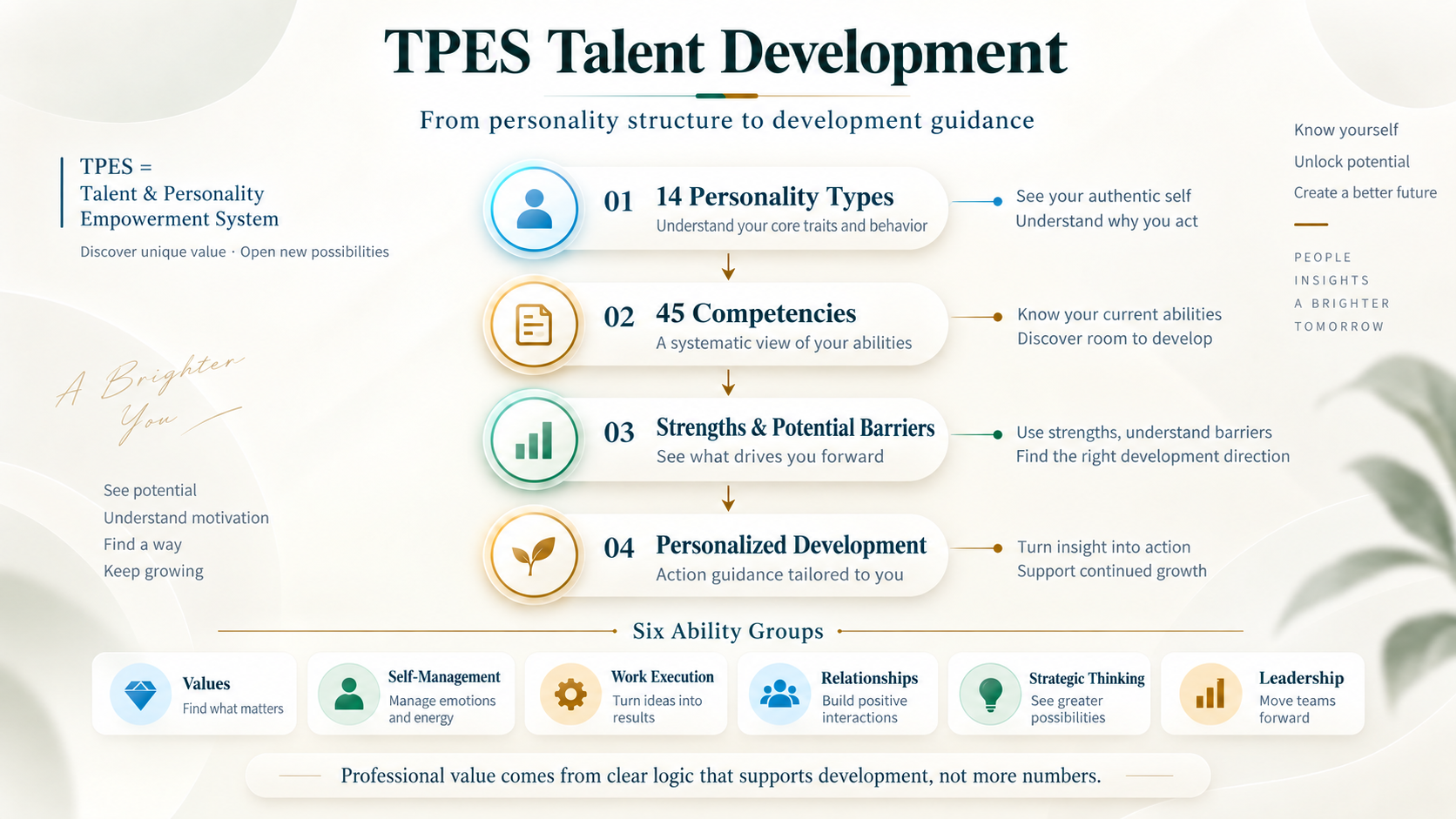
Personality reveals how you see the world, competencies help you accomplish tasks, and development suggestions bring both into real life.
View the Full DiagramKnowing what matters to you is a starting point. Managing yourself, completing work, collaborating, seeing a direction, and mobilizing a team determine how you contribute in a role. TPES uses six categories and 45 competencies to create a shared language and make development priorities more concrete.
People who hesitate to speak in meetings may have different reasons: some need time to organize their thoughts, some fear conflict, and others are still learning the work. Simply asking them to 'be more proactive' can miss the real cause. Combining personality, competencies, and observation on the job helps identify more suitable ways to practice.
Choose the competencies most relevant to your current role and describe goals in behavioral terms. For example, turn 'improve communication' into 'before assigning a task, confirm the other person's understanding of the outcome and deadline.' Small, clear actions are easier to practice, observe, and adjust.
What does this person tend to value when interests, responsibilities, and choices are at stake? Indicators related to integrity, accountability, courage, service, and achievement provide perspectives for discussing values.
This is not a moral rating. A lower score on an item does not justify concluding that someone is dishonest or lacks responsibility. Important judgments still require actual behavior and facts.
How does this person initiate action, stay engaged, learn and adapt, and handle pressure? This category includes initiative, learning mindset, work stamina, self-discipline, resilience, and emotional stability.
Emotional stability reflects tendencies related to emotional states. It should not be treated as a standalone work skill or used to make a psychological diagnosis.
When facing a task, how might this person analyze, organize, adapt, execute, and attend to quality? Analytical thinking, execution, adaptability, cost awareness, and meticulousness can help frame discussions about work methods and development priorities.
Actual professional performance still depends on knowledge, skills, experience, and working conditions, and must be verified through relevant observation or tasks.
How does this person understand others, express opinions, and accomplish things together? Listening, empathy, communication and coordination, teamwork, and customer focus can inform discussions about service, collaboration, and team interactions.
Being outgoing does not automatically mean listening well; being friendly does not mean handling conflict effectively. Evaluate each competency through concrete behavior, rather than replacing the whole judgment with one personality trait.
When facing uncertainty and issues that cross boundaries, how do you make judgments, integrate resources, see the whole picture, drive change, and recognize opportunities? This category connects management challenges with higher-level thinking requirements.
Not every role requires the same level of strategic thinking. Select model components according to role tasks, rather than seeking high scores on every indicator.
When a role requires achieving results through others, how do you influence, collaborate, delegate and hold people accountable, coach and empower, and lead a team? The five indicators are influence, collaboration, delegation and accountability, coaching and empowerment, and leadership and management.
'Teamwork' and 'collaboration' are distinct indicators; they should not be renamed interchangeably or merged. Roles without actual people-management responsibilities should not automatically be assigned every people-management requirement.
Atomic competencies are foundational units that can be combined. Businesses can select them for role requirements, schools can combine them for development goals, and relevant indicators can form application models for leadership and project management.
An application model is not another set of arbitrarily invented scores. It should explain which indicators are selected, why they are needed, how their importance is understood, and what external evidence is required.
An illustrative example, not an individual judgment. Similar attention to detail may reflect different drivers: valuing standards and responsibility, being skilled at calm review, or being particularly sensitive to irregularities.
The first person may need to learn how to prioritize checks; the second may need to explain their decision-making process to the team. Someone especially alert to anomalies can practice distinguishing facts from assumptions. Whether these approaches fit still depends on the person's actual personality combination and workplace experiences.
In reports that use these energy charts, Green Energy primarily helps explain potential or motivation, not proof of achieved performance. A reduction in green energy does not necessarily indicate a risk of overuse either.
Yellow or Red Alerts Interpret indicators according to their specific rules and the personality combination, rather than generalizing that 'high scores are a problem' or 'one type is too high.' Nor can simply subtracting risks from strengths represent a person's worth.
The same score may therefore call for different interpretations, development guidance, and limitations depending on its personality drivers.
Choose one key task, define observable behaviors, then use competency information to prepare a discussion and practical exercise. Afterward, use outcomes, feedback from others, and the person's experience to refine your understanding.
Every role needs a different combination of competencies. Start with the six categories to explore what each competency means and how to practice it in real work.
How do you motivate yourself, manage your pace, and keep moving through difficulties?
Recognize what is worth doing, take the first step, and actively seek opportunities to improve and develop. Turn the desire to grow into an action you can begin.
When you identify an obstacle at work, propose one improvement and explain what you can take on first.
Recognize your emotions under pressure, setbacks, and change, and adjust your responses so important conversations and work can continue.
When criticized, first clarify the specific issue being raised, then decide how to respond and address it.
Stay curious about new knowledge, willing to ask questions, experiment, and update existing ideas. Connect learning with real problems to keep expanding the ways you work.
After learning a new method, apply it to a task and record its effect and what to adjust next time.
Carry initial engagement through into execution, maintaining quality and follow-up. Long-term tasks require patience and a sustainable working rhythm.
Break a long-term goal into achievable weekly progress, with checkpoints and time to recover.
Form your own ideas, take responsibility for judgments and actions, and avoid waiting for instructions at every step. Autonomy also means knowing when to consult others or seek support.
When offering a recommendation, explain your reasoning, possible actions, and where cooperation from others is needed.
Recognize your responses, needs, and blind spots, and be willing to reflect on what works and what could change. Self-awareness gives growth a clearer starting point.
Review an important interaction. Separately note the facts, your interpretation, and where you could try a different approach.
Manage time and behavior according to goals and values, even without supervision. Notice when you stray and adjust promptly rather than relying on a brief surge of willpower.
Reserve a regular time slot for an important task, and check periodically whether priorities have actually been completed.
When faced with obstacles and setbacks, keep seeking workable approaches and support, then reengage. Stay committed to your goal while remaining flexible about the path.
After an unsuccessful attempt, identify the reasons, adjust one approach, and plan the next attempt.
Know your abilities and limits, and trust that you can take effective action when facing challenges. Test your judgments and accept feedback so confidence is grounded in experience.
Before taking on a new task, list your existing competencies, the resources you still need, and the first step you can complete.
What do you value, and how do you bring those values into your work?
Recognize your limitations and respect others' experience and contributions. Be willing to seek advice and accept corrections so your competencies keep growing.
When opinions differ, ask about the other person's reasoning before explaining your own judgment.
Maintain honesty and consistency in information, commitments, and actions. When mistakes occur or something cannot be done, explain clearly and take responsibility for addressing it.
When progress falls behind, explain the actual situation, impact, and recovery plan early. Do not obscure problems with vague language.
Identify with organizational goals and legitimate interests, honor commitments, stay engaged, and support the team's long-term development. Loyalty includes constructive contribution, not unconditional obedience.
When an approach harms the team's long-term interests, use facts to suggest improvements rather than remain silent.
Take ownership of responsibilities, problems, and results. When things go off track, avoid deflecting blame and actively arrange remedies, turning responsibility into action.
When a task you are responsible for goes wrong, first establish the impact and next steps, then review the causes and improvements.
Take necessary action after assessing responsibilities, unfamiliar challenges, or pressure. Courage is more than charging ahead; it includes a willingness to take responsibility and learn.
Identify an issue that needs discussion, prepare concrete facts and suggestions, and initiate that important conversation.
Stay engaged and enthusiastic about meaningful goals, and be willing to invest effort. Turning enthusiasm into sustainable action helps energize both you and your colleagues.
Explain why this work matters to you, and turn your commitment into concrete progress and promises.
Understand the needs of internal partners and the organization, providing timely, professional, sustainable support that makes cross-department work smoother.
Before helping another department, confirm the outcomes, deadlines, and resources they actually need.
Look toward the future, set clear goals, and sustain effort to achieve results. Bring your drive to do better into everyday choices.
Set outcome standards and milestones for a goal, then review regularly what remains to be achieved.
How do you put ideas into practice, solve problems, and deliver results?
A willingness to study work-related knowledge, techniques, and methods in depth and continually improve professional quality. This indicator reflects engagement in professional development; specific skills still need to be tested in practice.
Test what you have learned through a real piece of work or task, and ask someone experienced to review its quality and provide feedback.
Seek to understand the full story, compare information, clarify relationships, and then form a judgment. Give decisions a reasoned basis and keep your reasoning open to review.
When discussing a problem, list known facts, assumptions, and information still needing verification separately.
Keep attention and energy on key tasks, manage distractions, and sustain quality and efficiency through timely recovery.
Set aside uninterrupted work time. Complete one important task before responding to other messages.
Identify the problem that truly needs attention, analyze its causes, develop a workable solution, take action, and track results. Carry improvement through until the problem is resolved.
First clarify whom the problem affects and where it occurs, then compare options and confirm whether the response has improved the situation.
Adjust your approach and pace when facing new environments, tasks, and changes. Understand what matters in the change and find a way to engage.
When conditions change, reassess goals, constraints, and priorities, then adjust the original plan.
Understand and follow applicable policies, processes, and standards. When conflicts or unsuitable requirements arise, raise them through appropriate channels so rules can continue to improve.
Confirm the necessary standards before starting a task. When exceptions arise, explain why and propose an approach.
Notice the key details that affect outcomes, think thoroughly, and seek accuracy. Focus checks where they matter most, balancing quality and delivery.
Before delivery, check content according to risk and importance. Distinguish what must be corrected from what can be improved later.
While working toward goals, pay attention to the use of time, money, and resources. Reduce unnecessary consumption so the same investment creates more value.
Compare the costs, quality, and ongoing maintenance needs of two approaches, not just their upfront prices.
Turn goals and tasks into concrete steps, keep them moving, and complete delivery. Give ideas progress and commitments results.
Clarify who is responsible for what, when it is due, and how to report and resolve obstacles.
Be willing to examine existing assumptions and methods, propose valuable new ideas, and turn them into usable results through testing and refinement.
Propose a new approach to an existing process, compare results in a small pilot, then decide whether to expand it.
How do you see the whole picture, integrate resources, and make choices for the future?
When a decision is needed, identify key information, make a clear choice, and move execution forward. Continue monitoring results after deciding.
Set a deadline for a decision and explain its basis, main risks, and follow-up checkpoints.
Organize people, information, tools, and funds effectively so resources work together to support goals and development.
Review available resources and gaps. Identify what can be shared and what needs to be added or reallocated.
Take a broad, long-term view and understand how your decisions affect other departments, customers, and future development.
When proposing a departmental plan, explain its effects on upstream and downstream processes, customer experience, and long-term costs.
A willingness to face new challenges and drive change, moving organizations and ways of working toward new possibilities. Beyond accepting new ideas, it includes enabling real transformation.
When introducing a new approach, explain why change is needed, who is involved, what support is required, and the expected outcomes at each stage.
Keep track of changes in markets, customers, and the wider environment. Identify opportunities worth exploring and turn them into development directions for discussion.
Turn observed needs into testable hypotheses, and check with actual users whether the problem exists.
How can you understand others, build trust, and collaborate more effectively?
Attend to the other person's words, feelings, and main points while suspending your own judgment. Clarify, paraphrase, and confirm to understand what they really want to say.
Before responding, summarize the main points you heard and ask the other person to confirm your understanding.
Try to understand the other person's situation and feelings from their perspective, and express that understanding. Ground the conversation in feeling understood while respecting each other's boundaries.
Ask what is most difficult for the other person right now. Understand their needs before discussing solutions.
Adapt communication to the person and situation so different needs can be expressed and discussed, and find arrangements that allow everyone to move forward together.
When opinions differ, clarify shared goals, each party's needs, and acceptable options separately.
Interact with warmth, respect, and kindness so others feel comfortable approaching, communicating, and collaborating with you.
Even when disagreeing, explain the issue clearly without belittling the other person.
A willingness to connect with people, understand different needs, and nurture relationships over time. Move beyond introductions toward mutual support.
After meeting a new collaborator, note what matters to them and arrange a meaningful follow-up conversation.
Work with colleagues toward shared goals and assigned responsibilities, complete your own work, and support smooth team delivery.
Identify who depends on your deliverables, share progress promptly, and help resolve shared obstacles.
Include customers' real needs and interests in work decisions, and keep checking whether the outcome solves their problem.
Confirm the client's goals before proposing a solution, and learn about their actual experience after delivery.
Actively pursue customers and partnership opportunities, handle the challenges of outreach, follow-up, and expansion, and keep developing business relationships.
Identify people worth connecting with and their needs. Plan purposeful outreach and follow-up.
How can you mobilize colleagues, coordinate responsibilities, and help the team grow together?
Through clear communication, leading by example, and understanding others' needs, help colleagues support the direction, take action, and strengthen team morale.
Explain why the goal matters to the team and invite members to suggest how they can contribute, rather than simply issuing demands.
Assign roles and coordinate relationships and resources with the whole team in mind. Help different members work toward a shared direction and improve organizational efficiency.
When work gets stuck across roles, clarify responsibilities, handovers, and shared accountability, then coordinate practical arrangements.
Assign work to suitable people, clarify outcomes, authority, and responsibilities, and follow up with necessary support. Connect delegation to results.
When delegating, agree on the scope of independent decisions, reporting checkpoints, and situations that require the manager's help.
Recognize others' potential and areas for development, and offer practice, feedback, and support to help colleagues grow through real work.
Assign a challenging task suited to a team member's development needs, then give specific feedback and discuss next steps after completion.
Understand people and tasks, set direction, divide responsibilities, and organize execution so team members can contribute individually and achieve important outcomes together.
Connect goals, talent allocation, and tracking mechanisms, regularly reviewing results and the team's needs.
 Calm AnalysisShare your reasoning
 Responsibility and QualityPractice Defining Standards and Making Trade-Offs
 Sensitivity and CautionClear feedback and step-by-step verification
 Alertness and InsightConfirm facts and their significance
An interpretation example, not a claim that one type determines a competency. Understanding the drivers helps development fit the person.
Some check each detail through calm analysis; some insist on quality out of responsibility; some carefully anticipate how details will affect others; others spot inconsistencies through alert insight. Similar competency performance does not always arise from the same way of engaging.
People who revise excessively need practice defining completion criteria and making trade-offs. Those who fear mistakes need clear feedback and step-by-step verification. Independent analysts can strengthen information sharing and collaboration. Those who readily spot concerns can practice checking the facts and distinguishing what matters most.
Some people inspire through vision and confidence, some move things forward decisively, some maintain quality through standards and responsibility, and others coordinate tasks through reason and insight. First clarify what the role must achieve, then tailor practice and support to individual strengths so development truly reflects each person's needs.
COMMON QUESTIONS
Find useful answers to the questions in front of you.
No. Different jobs require different combinations of competencies, and those requirements change with the role. Clarify tasks and expectations first, then discuss relevant competencies to establish a meaningful development direction.
Choose one competency most relevant to your current task, write down the specific behavior you want to see, and create an opportunity to practice. Use work feedback, coaching support, and regular reviews to adjust your approach.
Teamwork focuses on mutual support, cooperation, and fulfilling your responsibilities within a team. Collaboration is part of Leadership & Management, focusing on coordinating relationships, roles, and resources so the whole team works toward a shared direction. They are connected, but their interpretation and development priorities differ.
The same competency can grow from different personality drivers and work experiences. For example, thoroughness may stem from responsibility, calm analysis, caution, or vigilance. Understanding those drivers before discussing speed, trade-offs, feedback, or collaboration makes development more responsive to individual needs.
TAKE YOUR NEXT STEP
Tell us your role, needs, and region,
We will help you find the right TPES platform, service, or partnership contact.