Adolescent Development
Use interests, personality, and learning experiences to explore further education, fields of study, and future work. Help children understand themselves better and adults support them more thoughtfully.
Learn MoreTPES ASSESSMENT
An assessment is worth more than its scores. TPES starts with questions from different life stages, helping you recognize strengths and clarify direction so your report becomes a starting point for conversations about work, learning, family, and growth.
From personality combinations and work directions to competency drivers and development strategies, explore actual report pages to see how TPES connects self-understanding with careers and action.
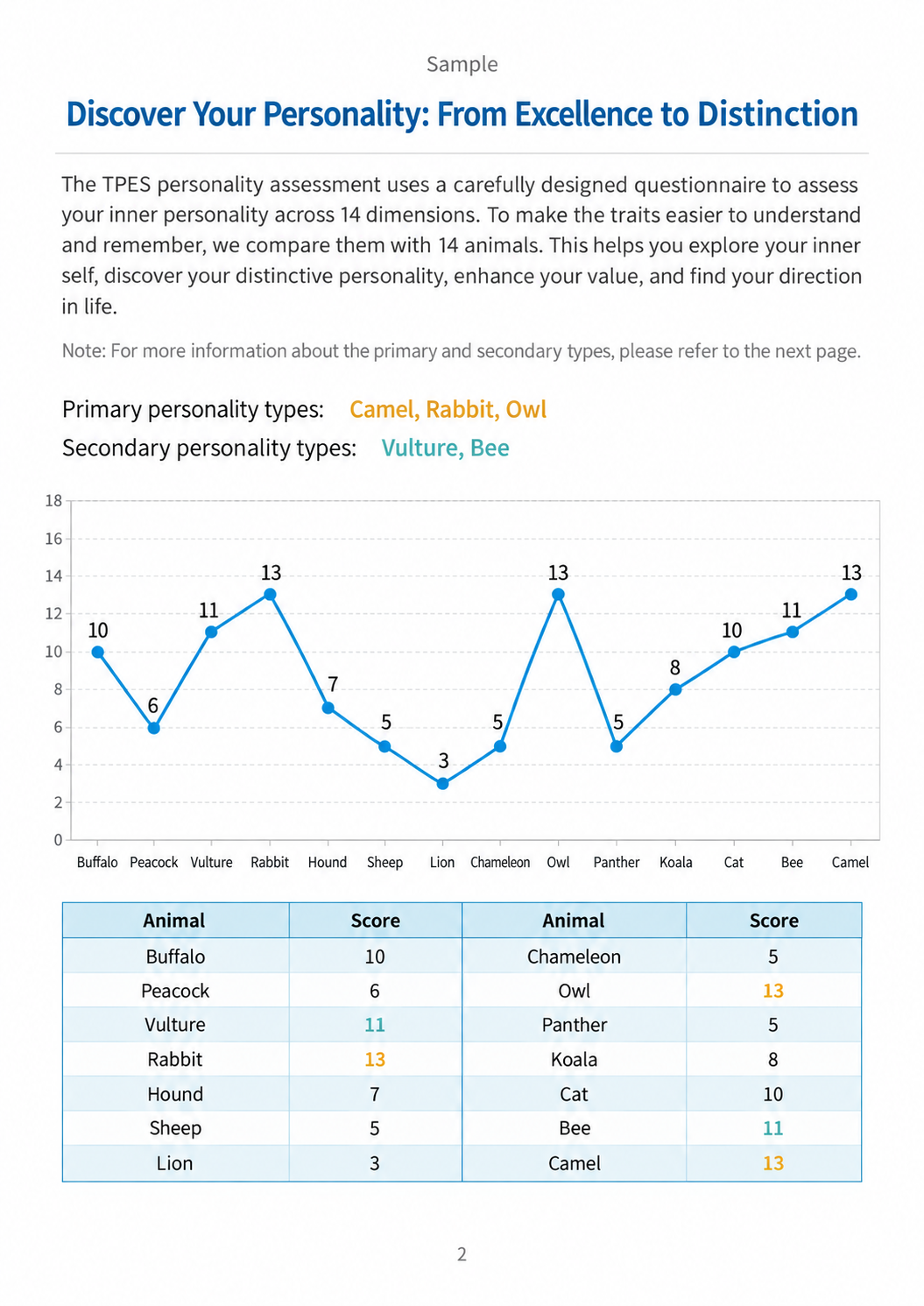
Personality and occupational competency report-reading example: 12 core occupational competencies version. The following excerpts omit names and contact details. Values belong only to this example and do not represent your assessment results.
You can be sensitive, committed, and thoughtful all at once. The report brings 14 dimensions together to show how different traits shape your way of working. Primary and secondary types are a starting point; the full combination brings deeper understanding.
Where am I most engaged? Which habits help me do well, and in which situations do I get stuck?
| Personality Dimensions | Sample Values |
|---|---|
| Buffalo | 10 |
| Peacock | 6 |
| Vulture | 11 |
| Rabbit | 13 |
| Hound | 7 |
| Sheep | 5 |
| Lion | 3 |
| Chameleon | 5 |
| Owl | 13 |
| Panther | 5 |
| Koala | 8 |
| Cat | 10 |
| Bee | 11 |
| Camel | 13 |
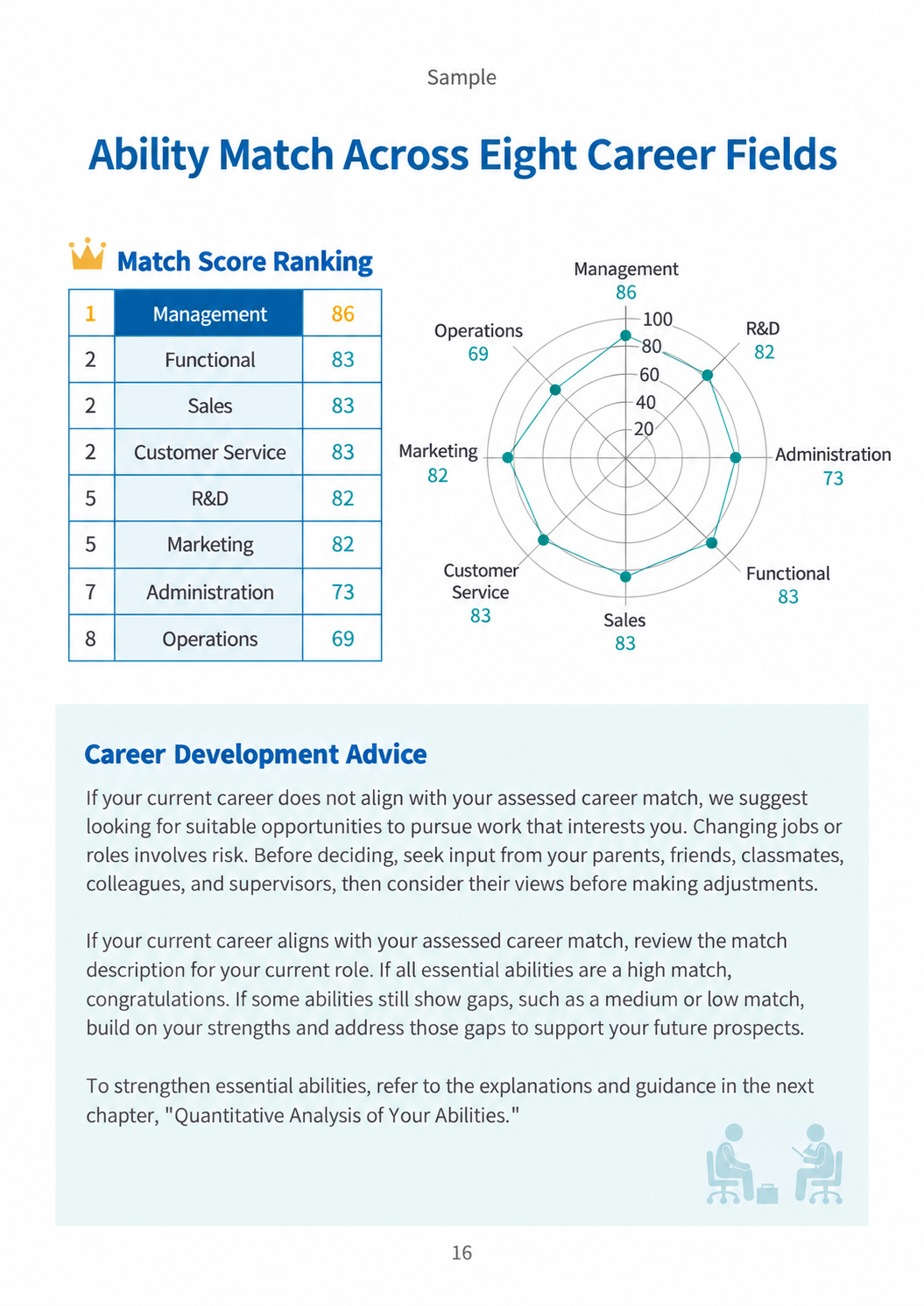
Management, specialist functions, sales, customer service, research and development, marketing, administration, and operations offer eight directions for exploring work. First identify areas worth investigating, then ask what competencies the work really requires, what experience you already have, and what else you can build. Fit analysis helps make your next career conversation more focused.
What can I contribute in this kind of work? Which tasks do I enjoy? What else do I need to prepare for my next role?
| Work Domains | Sample Fit Scores |
|---|---|
| Management Roles | 86 |
| Functional | 83 |
| Sales | 83 |
| Customer Service Roles | 83 |
| Research and Development | 82 |
| Marketing | 82 |
| Administrative Roles | 73 |
| Operations | 69 |
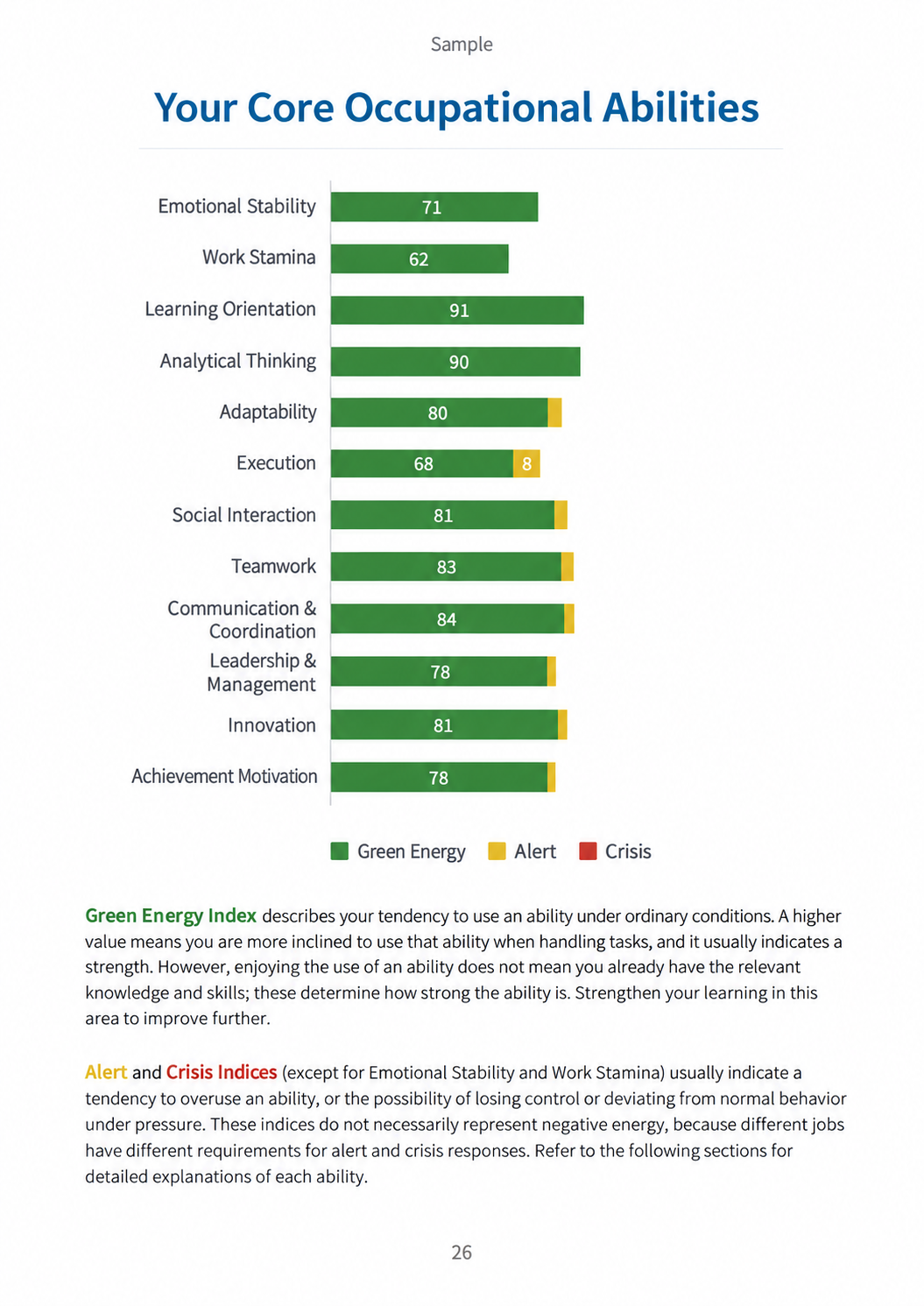
This sample uses 12 core occupational competencies to show how a person tends to engage with and handle tasks. Green energy reflects the tendency to use a competency; warning and crisis indicators highlight possible overuse or responses under stress. Adding knowledge, skills, and actual performance gives you a fuller basis for discussing how to put those competencies to work.
Which competencies naturally draw me in? When do I need to adjust my approach? What exercises can turn my potential into consistent performance?
| Core Occupational Competencies | Example Green Energy |
|---|---|
| Emotional Stability | 71 |
| Work Stamina | 62 |
| Learning Mindset | 91 |
| Analytical Thinking | 90 |
| Adaptability to Changing Environments | 80 |
| Execution | 68 |
| Social Skills | 81 |
| Teamwork | 83 |
| Communication and Coordination | 84 |
| Leadership & Management | 78 |
| Change and Innovation | 81 |
| Achievement Motivation | 78 |
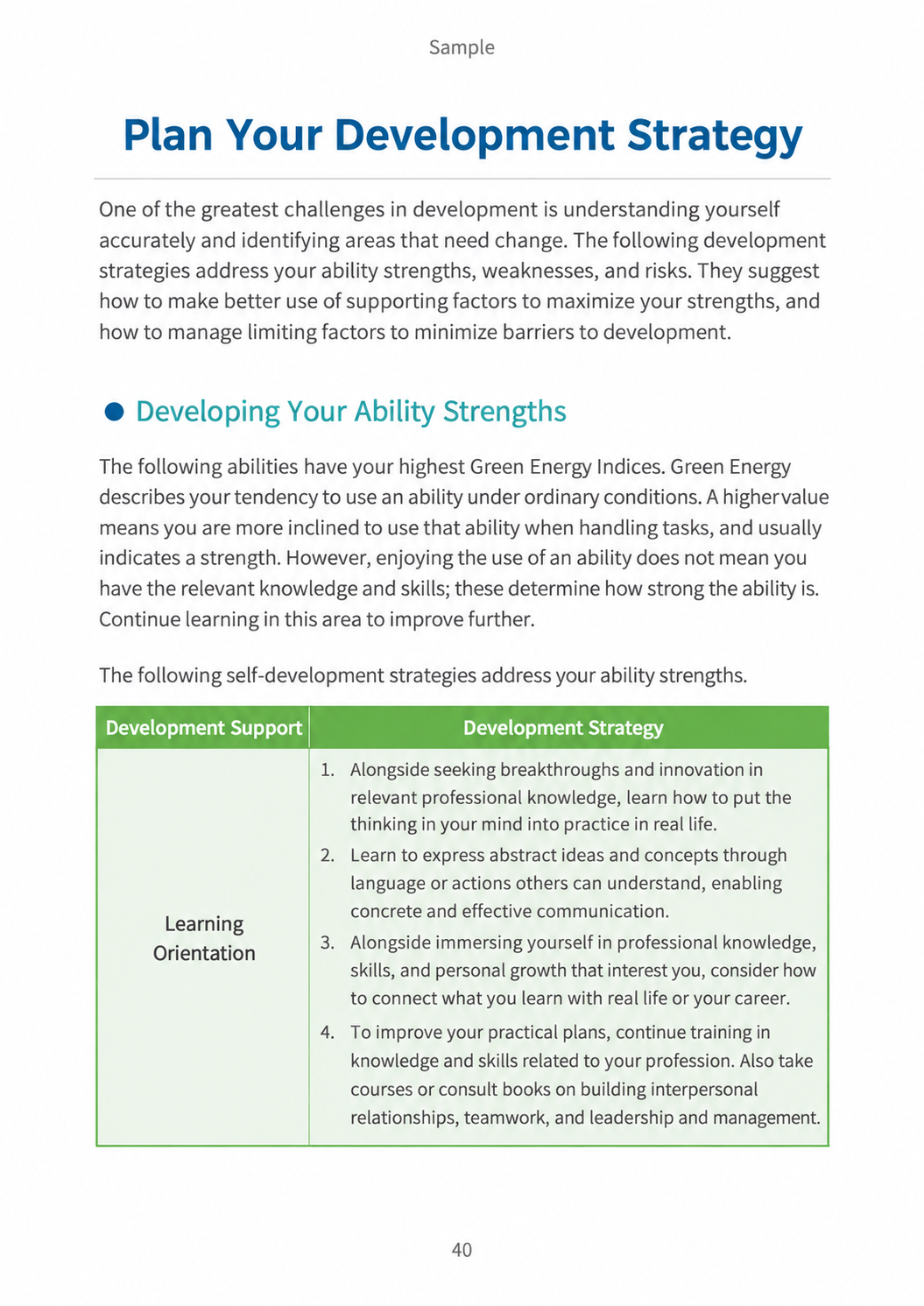
The report goes beyond scores. For a learning mindset, for example, it encourages not only continued learning but also turning ideas into tangible work, explaining them clearly to others, and connecting them to real work. This moves the question from 'What are my strengths?' to 'How can I use them?'
Which work issue can you choose this week to apply what you have learned? Afterward, who can help you review the outcome?View the Full Report Pages
From learning and careers to leadership and parenting, different questions call for different perspectives. TPES report series connect talent, personality, and development to the parts of life that matter to you.
Use interests, personality, and learning experiences to explore further education, fields of study, and future work. Help children understand themselves better and adults support them more thoughtfully.
Learn MoreDo not treat one score as the whole picture. Explore possibilities in learning and performance through different dimensions of intelligence, combining actual work and experience to identify directions worth developing.
Learn MoreIdentify situations that create tension, habitual responses, and needed support to guide discussions about managing stress, communication, and daily practice.
Learn MoreFocus on how children learn, interact, and express themselves. Help parents and educators understand differences rather than expect every child to meet a single standard.
Learn MoreChildren need understanding, and so do parents. Explore expectations, parenting habits, and parent-child interactions to find changes the family can try together.
Learn MoreExplore people management, communication, delegation, and motivation to identify managers' strengths and blind spots, keeping leadership development grounded in the team's real work.
Learn MoreBring together your traits, competencies, expectations, and work experience to explore roles worth pursuing and competencies to build for your next stage.
Learn MorePersonality understanding, competency analysis, motivation, and development recommendations are connected. Rather than simply telling you your type, they help you see how you can contribute.
Different numbers describe different levels of the framework, not accuracy rates or client counts. Report interpretation, contextual discussion, and development support help turn the information into a useful next step for you.
Bring your experience back into the conversation for a next step that fits you better.
Ask yourself: What do I most want to improve right now? Choosing a field of study, changing jobs, leading a team, or communicating with my child? With a clear context, assessment information is easier to turn into answers that matter to you.
As you read your report, think of a recent example. Which descriptions match your experience? Which need further checking? Discussing them with a coach, consultant, or service team helps bring the information beyond the page.
Choose the direction most worth your effort, set small, concrete steps, and review what actually happens. TPES helps turn an understanding of individual differences into purposeful development. Report content and eligible ages depend on the assessment and service plan selected.
Light-Touch Personality Exploration. For people new to TPES who want to learn the language of personality. It offers a starting point for self-observation and sharing, but does not replace a formal assessment.
Formal TPES assessment. For people who want a deeper understanding of their personality combination, development direction, or specific report content. Applicable ages, questionnaire versions, and report scope depend on the actual service.
Organizational or project assessments. For businesses, schools, and professional institutions. First confirm the purpose, participants, data scope, and interpretation approach, then arrange assessment and subsequent applications.
You already have a TPES report. Return to your original service entry point to confirm your report version, access entitlements, and available follow-up services. You do not need to purchase again simply to view the updated website.
Know whether this assessment is for self-exploration, a development discussion, or an organizational talent project. Different purposes call for different information and depths of interpretation.
Understand who will use the data and what permissions they have, then answer according to your actual circumstances. Do not simply choose answers you think make you look like a better employee.
Start with the personality combination and the report's purpose, then review each competency and caution. Avoid focusing only on the highest or lowest indicator.
Use recent events at work, in learning, or in life to check which descriptions help and which need further clarification.
For example, prepare an interview, adjust a communication approach, arrange a practical task, or begin a coaching conversation.
Look at the combination before individual dimensions. Even a prominent trait needs to be understood within the whole personality and its context.
Consider potential and demonstrated performance separately. Willingness to engage or a natural tendency does not mean someone already has sufficient knowledge, skills, and experience.
Consider strengths and risks separately. Risk indicators help discuss possible limitations and adjustments; they do not mean the person will necessarily experience a particular problem.
Leave room for revision. When a report differs from actual experience, examine the circumstances of completing the questionnaire, the data version, and behavioral evidence. Do not require the person to fit the description.
Assessments can support self-understanding, interview preparation, talent discussions, learning exploration, and development priorities. Hiring, promotion, placement, and other high-impact decisions still require skills, performance, task observations, and information from multiple sources.
TPES personality and risk information is not a medical or mental health diagnosis. When professional support is needed, an appropriately qualified professional should conduct an evaluation.
Individuals can use TPES Coach. Coaches and institutions can use TPES Agent within their authorized scope. Businesses and schools can access competency, role, or development programs according to their project objectives.
COMMON QUESTIONS
Find useful answers to the questions in front of you.
Start with the question you want to address. For learning and study choices, explore the adolescent and multiple intelligences series. For work roles and growth, explore the career or leadership series. For parent-child interactions, explore child development and parenting styles. The team can help you choose based on age, context, and available plans.
Find the content most relevant to your current question, bring one real example to interpretation and discussion, and choose one small action you can take. Recording what happens after trying it is more useful than simply remembering a type or score.
Gain a clearer picture of your personality combination, work directions worth exploring, how you apply your competencies, and development actions you can begin. Read the report alongside recent real-life experiences, then discuss it with a coach, consultant, or manager to turn understanding into momentum for your next step.
They help you first identify the more prominent traits in a combination. Everyone has 14 personality dimensions, whose varying strengths form an individual profile. Identifying with one animal does not mean ignoring the other traits.
Green Energy reflects your tendency to use a competency under ordinary conditions; it does not mean you have mastered all the related knowledge and skills. Identify directions you naturally want to pursue, then combine training, experience, and feedback to turn strengths into work results.
Color alone cannot determine the answer. This information flags responses worth exploring, such as overusing a competency or how someone performs under pressure. Its meaning varies by indicator. Consider tasks, working conditions, and actual behavior together before discussing adjustments and support.
This personality and occupational competency report uses 12 core occupational competencies to demonstrate how to interpret personality, career directions, and development strategies. The website also presents a model with six categories and 45 competencies. Their analytical scopes differ; the report you receive depends on your selected assessment and service version.
Treat it as a direction worth exploring, not an instruction to change jobs immediately. First understand the tasks, skill requirements, your interests, and practical constraints. Build experience through interviews, short practical projects, or further study before making a more informed career choice.
TAKE YOUR NEXT STEP
Tell us your role, needs, and region,
We will help you find the right TPES platform, service, or partnership contact.